Benchmarks
Every number on this page comes from a script in the repositories, with its raw results, on an Intel i9-14900K with 24 cores and 62 GB of RAM unless it says otherwise.
qevedo-simulator
Same circuits, same machine: an Intel i9-14900K with 24 cores and 62 GB of RAM. Lower is better.
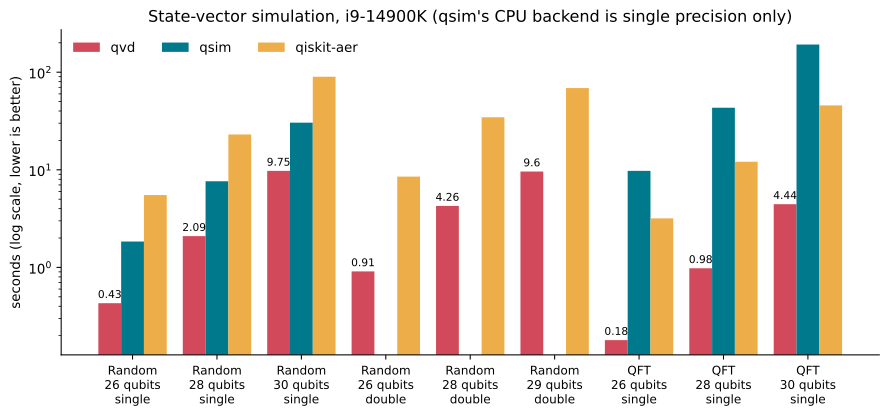
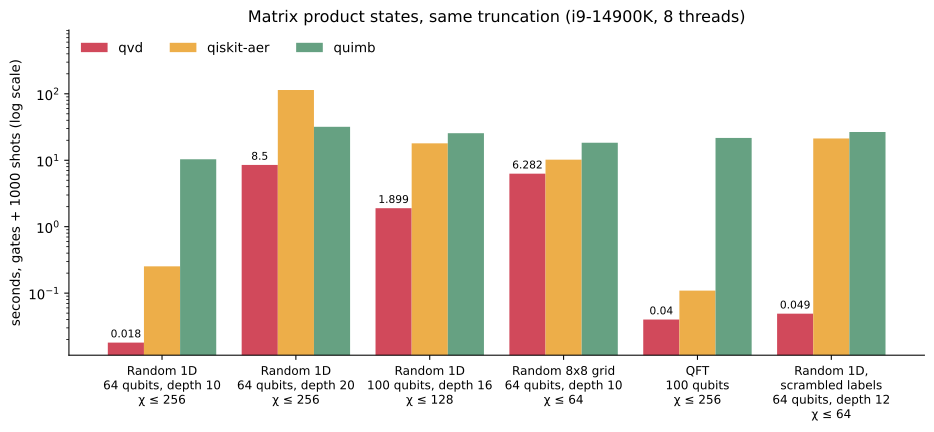
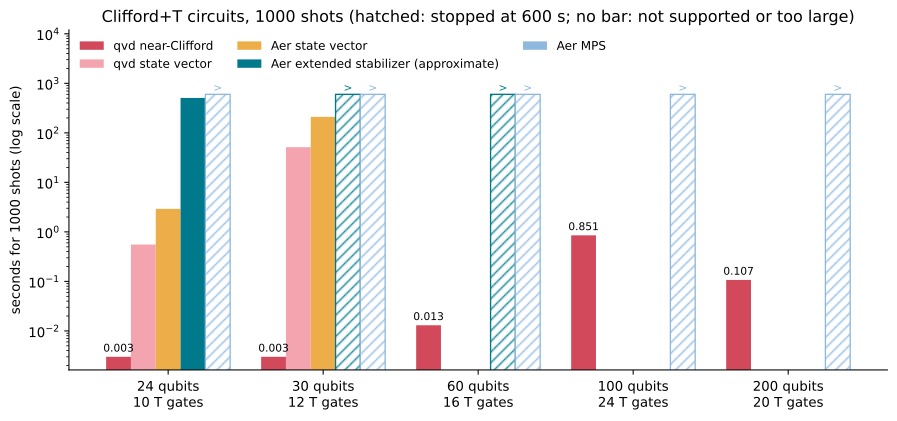
<Z62> of IBM's 127-qubit, 20-step kicked Ising utility circuit by Pauli propagation in 0.25–9.6 s: the same value and strings as IBM's pauli-prop, 15–117× faster end to end on 4 threads. Measured on a 4-vCPU Intel Xeon virtual machine.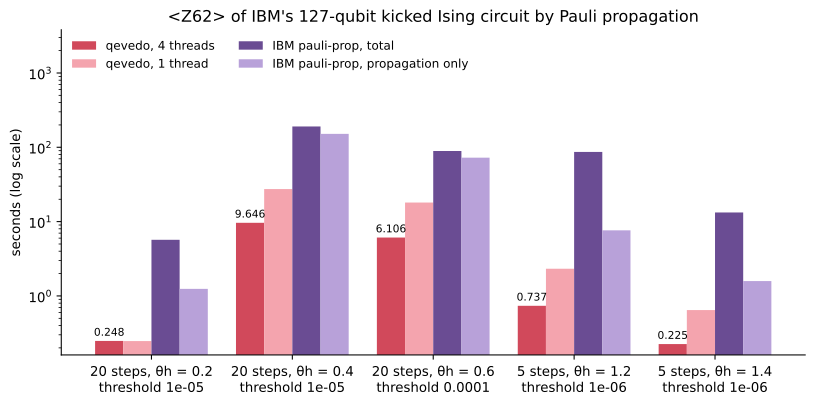
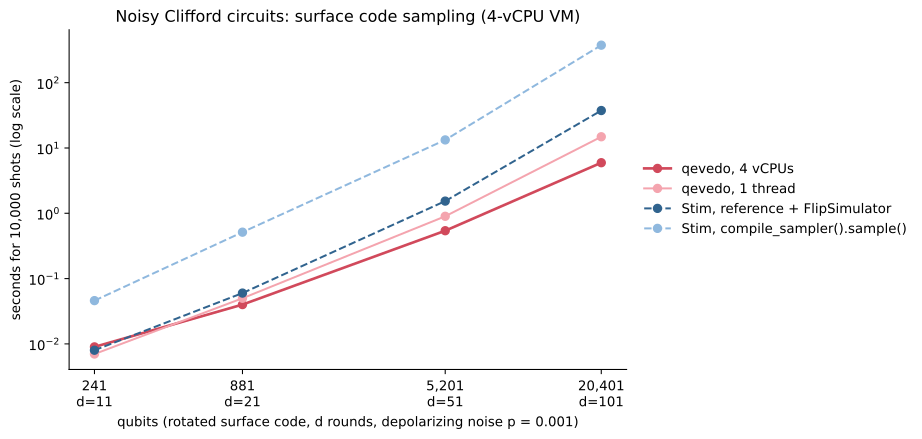
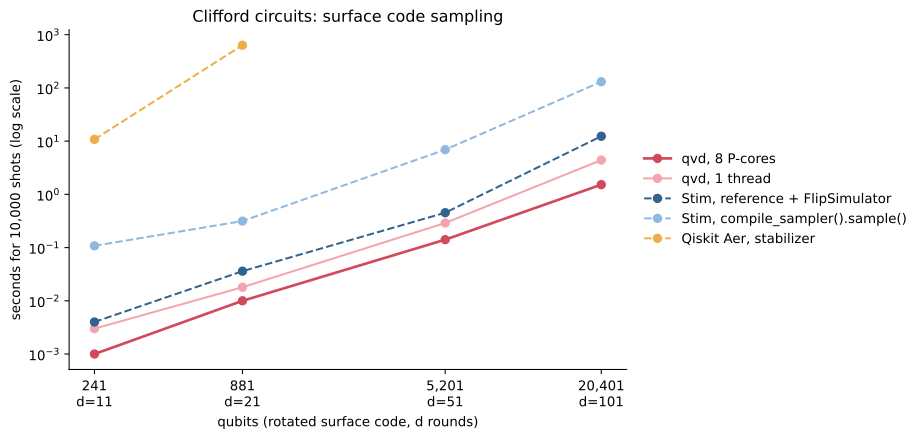
MPP, L rounds, with depolarizing noise, a biased PAULI_CHANNEL_2 and correlated E/ELSE_CORRELATED_ERROR chains, p = 0.001, 10,000 shots of detection events (qevedo-simulator 0.1.5): L = 10, 20, 30 in 0.021, 0.162 and 0.787 s on 4 vCPUs (0.019, 0.173, 0.898 s on one thread) against 0.083, 1.116 and 4.310 s for Stim's detector sampler. Four threads gain little at these sizes. Detection rates agree with Stim's, no detector fires without noise, and decoded logical error rates over 4–12 million shots per simulator differ by |z| ≤ 2.03, in both directions. Measured on a 4-vCPU Intel Xeon virtual machine (bench_mpp.py).backend.run on QevedoSimulator and on Qiskit Aer 0.17, 1000 shots, conversion included (qevedo-simulator 0.1.6): Quantum Volume 20, 24, 26 and 28 in 0.041, 0.264, 1.23 and 5.91 s against 1.31, 3.36, 10.4 and 39.0 s (32×, 13×, 8.5×, 6.6×); QFT 24 and 28 in 0.143 and 3.70 s against 2.88 and 29.4 s. QevedoEstimator against Aer's EstimatorV2 on Quantum Volume 16, 20 and 22 with 50 Pauli observables: 0.039, 0.102 and 0.317 s against 1.17, 1.58 and 1.75 s, values equal to 6e-17. A 500-qubit Clifford circuit, 10,000 shots: 0.023 s against 80 s for Aer's stabilizer method, which simulates every shot again when the circuit measures. Measured on an Intel Core i9-14900K shared with other jobs (bench_qiskit.py).Method, raw data and scripts to reproduce every number: qevedo-simulator/benchmarks.
qevedo-compiler
24 circuits (QFT, QAOA, Quantum Volume, GHZ, Heisenberg, adders, Clifford+T, random Hamiltonians) of 8 to 32 qubits, compiled for rz, sx, x and cx; QCC uses no more two-qubit gates than Qiskit on any of them. Gates relative to Qiskit at optimization level 3 (geometric means) and median time, on a 4-vCPU Intel Xeon virtual machine; lower is better.
| Compiler | 2q gates | All gates | Time |
|---|---|---|---|
| QCC | 0.923× | 0.863× | 5 ms |
| Qiskit | 1.000× | 1.000× | 10 ms |
| pytket | 0.998× | 1.093× | 1497 ms |
| UCC | 1.015× | 2.400× | 29 ms |
On a chip. Compiled for a 19-qubit heavy-hex chip, QCC lays out and routes the circuit itself: with no SWAP when the circuit fits, otherwise with SABRE counting each SWAP for what it costs once merged with its neighbours. Since 0.4.8 it routes each layout 16 times rather than 4, and also optimizes the routing the first 4 would have kept, so no circuit gets worse: Quantum Volume at 16 qubits went from 822 to 783 two-qubit gates (Qiskit 828), Clifford+T at 16 from 752 to 733 with CX and 708 to 692 with CZ, the 16-qubit Hamiltonian from 1368 to 1336 with CX and 1292 to 1256 with CZ. SABRE itself got 2–3× cheaper in the same release, with the same choices, so this costs little: 0.86× the time of 0.4.7 with CX and 0.97× with CZ. Since 0.4.11 it also carries the end of a two-qubit block through the gates between into the next block on its pair (methods page): the 16-qubit Hamiltonian 1336 → 1321 CNOTs with CX and 1256 → 1231 CZs with CZ (4454 → 4208 gates in all), the 8-qubit one 345 → 335 CNOTs, the 16-qubit adder 148 → 146; no circuit got more two-qubit gates. Since 0.4.13 Pauli pairs (methods page) remove single-qubit gates left between two-qubit gates: on the chip the Heisenberg chain 571 → 559 gates and the 16-qubit Hamiltonian 2099 → 2091 with CX, Clifford+T at 16 qubits 2677 → 2668 with CZ; no circuit got costlier. Since 0.4.14 rotation pairs (methods page) go further, once on the final result: on the chip the 16-qubit adder 402 → 395 gates with CX, Clifford+T at 16 qubits 2668 → 2664 with CZ; no two-qubit gate count changed and no circuit got costlier. Since 0.4.15 Pauli networks are also synthesized on the chip's own couplings (methods page), where before they were synthesized as if every qubit were coupled and then routed, which never paid: the 8-qubit Hamiltonian 335 → 189 CNOTs and the 16-qubit one 1321 → 1078 (Qiskit 425 and 1463), with CZ 307 → 184 and 1231 → 1095 CZs (Qiskit 427 and 1477); on 24 other random Hamiltonians of 6–16 qubits 15–35% fewer two-qubit gates, every one; no other circuit changed. It costs time there: the 16-qubit Hamiltonian takes 1.4 s instead of 0.5 with CX and 3.0 s instead of 2.1 with CZ, side by side with 0.4.14 (Qiskit 0.1 s). Since 0.4.16 the Clifford those networks leave at the end is synthesized on the chip's couplings too (methods page), where before it was routed: the 8-qubit Hamiltonian 189 → 187 CNOTs and the 16-qubit one 1078 → 1063, with CZ 184 → 181 and 1095 → 1030 CZs; on 22 other random Hamiltonians of 6–16 qubits 3.8% fewer CNOTs and 3.5% fewer CZs, none with more; no other circuit changed. It costs 1.10–1.38× the time on those Hamiltonians (16 qubits: 1.67 s with CX, 3.96 s with CZ, side by side with 0.4.15). On the chip QCC is faster than Qiskit with CX (a median of 26 ms against 31 in the 0.4.16 run) and slower with CZ (71 ms against 40, where since 0.4.4 it optimizes again until the circuit stops shrinking). QCC still uses more two-qubit gates than Qiskit on one circuit, Quantum Volume at 8 qubits (111 against 108), where Qiskit itself gives 108 or 111 depending on its seed. Since 0.4.5 it runs independent work side by side on all cores, SABRE's layout trials and the candidate compilations among them (0.51× the time of 0.4.4 on the chip with CX and 0.62× with CZ, on 4 vCPUs), and since 0.4.6 all the pipelines of a compilation share their two-qubit syntheses (0.83× the time of 0.4.5 with CZ), both with byte-identical outputs. Without a chip it is faster on 19 of the 24 circuits, but slower on the Hamiltonians at 8 and 32 qubits (where it tries twelve Pauli networks: 126 ms against 18 at 32 qubits), on Quantum Volume at 16 and 32 qubits (114 ms against 60 at 32) and on Clifford+T at 32 qubits (19 ms against 14; single compilations in the 0.4.14 run). Rotation pairs cost 1.03× the time of 0.4.13 without a chip and 1.00× on it, side by side. Pauli pairs cost 1.04× the time of 0.4.12 without a chip and 1.03× on it with CX, side by side. Carrying costs 1.05× the time of 0.4.10 without a chip and 1.07× on it, side by side. Version 0.4.10 compiles the Hamiltonians 2–3× faster than 0.4.9 with identical outputs (32 qubits 340 → 110 ms with CX, side by side). Version 0.4.9 takes 0.85× the time of 0.4.8 without a chip (Quantum Volume at 32 qubits 149 → 92 ms, side by side), 0.93× on the chip with CX and 0.83× with CZ, with identical outputs; 0.4.3 took 0.73× the time of 0.4.2.
| Heavy-hex, 8–16 qubits | 2q gates | All gates | Time |
|---|---|---|---|
| QCC, CX | 0.879× | 0.788× | 26 ms |
| Qiskit, CX | 1.000× | 1.000× | 31 ms |
| QCC, CZ | 0.858× | 0.805× | 71 ms |
| Qiskit, CZ | 1.000× | 1.000× | 40 ms |
Inside Qiskit. As Qiskit's optimization stage, transpile(circuit, backend, optimization_method="qcc"), on a heavy-hex chip: with CX, 3% fewer two-qubit gates and 16% fewer gates in all, up to 61% on a QFT; with CZ, 7% fewer two-qubit gates and 17% fewer gates in all.
Scripts and results: qcc/benchmarks/compilation.
Multi-core mapping
Mapping circuits onto modular quantum computers, cores joined by quantum links, in qevedo-compiler. Benchmarks of Escofet et al. (QFT, adders, random circuits, Quantum Volume, built with Qiskit); fewer teleportations is better.
| Comparison | Result |
|---|---|
| HQA against FGP-rOEE, 105 configurations | 1.24× fewer teleportations (mean), 7.8× faster (median) |
| HQA counting link hops, cores in a ring, grid or line | 1.6–1.9× fewer than FGP-rOEE |
| HQA with ports against TeleSABRE, its own device and circuits | 0.26× the EPR pairs, 0.51× the SWAPs (geometric means) |
| HQA-latency against HQA, 1 to unlimited EPR pairs per link | 6–12% shorter circuits on average, never longer |
HQA is the Hungarian Qubit Assignment of Escofet et al.; HQA-latency and the routing inside cores are ours. TeleSABRE deadlocks on random circuits and Quantum Volume in all 100 of its attempts; on the 8 circuits it completes, HQA with ports uses fewer EPR pairs and fewer SWAPs on every one. Try the mappers in the multi-core playground.
Method, results and caveats: qcc/docs/MULTICORE.md.